Article: A Table After Frida
A Table After Frida
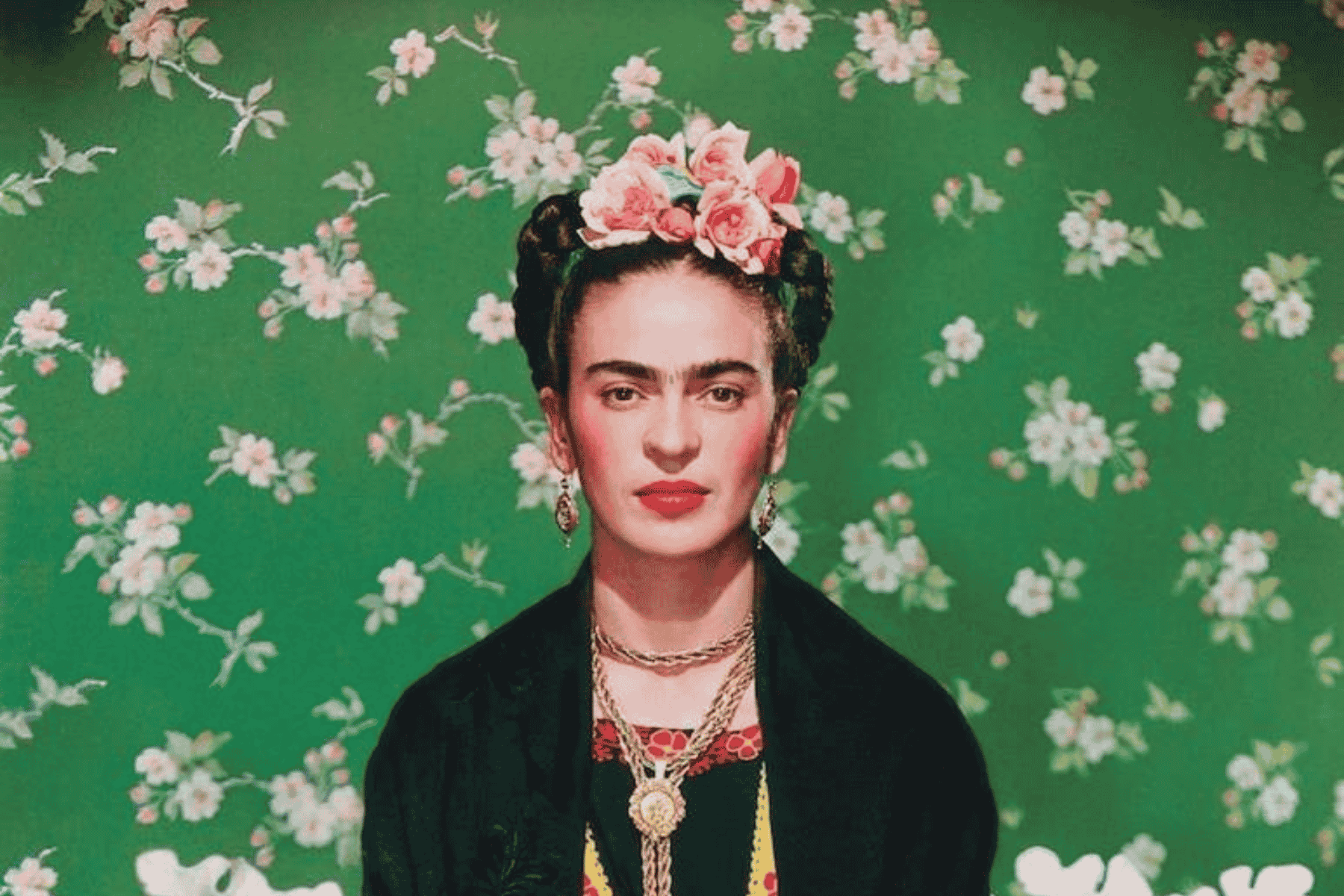
Frida Kahlo is at Tate Modern until January. Her paintings are a lesson in how Latin America uses colour, pattern and nature — a vernacular that runs a long way past Mexico. Here is what it teaches, and how we set a table around it.

What does Frida Kahlo's art teach us about Latin American visual language?
Four things: colour used at full strength, a flat and face-on composition borrowed from devotional folk painting, nature placed inside the frame rather than behind it, and pattern used as structure rather than decoration.
These aren't exclusively Mexican. They are part of a visual language forged through common ancestry, spoken in different accents across the region — and Kahlo is the most famous person ever to use all four at once.
Colour is a statement, not an atmosphere
She painted at full saturation and rarely mixed toward a mood. Colour arrives declaring something — she kept notes in her diary assigning meanings to particular ones. European painting of the same decade was mostly using colour to describe light. Hers is used the way a flag uses it, as a symbolism.
The composition is flat and face-on
Kahlo collected ex-votos — small devotional paintings on tin, made as thanks for a granted prayer. Their conventions are all over her work: no European depth, no vanishing point, the subject front and centre, the ground filled rather than receding. This is the single most portable thing about her style, because that devotional folk tradition exists right across Catholic Latin America.
Nature is a guest, not a backdrop
Look at where she puts the leaves. They aren't landscape behind a portrait — they press into the same plane as her face, at the same scale, sometimes in front of it. Monkeys and parrots sit at shoulder height, looking out at you. Nature is in the room, not through the window.
Pattern is structure
Textiles, veins, leaves and hair repeat until the field is full. There is no empty ground to rest in. It's the same logic as woven geometry: pattern isn't applied to the object at the end, it's what the object is made of.
What colours did Frida Kahlo use, and why?
Cobalt blue, marigold, and the deep pink of bougainvillea — the colours of the walls, plants and light around her, used at full strength rather than muted for a room.
She never dressed down a room and she never dressed down herself. The Casa Azul was, as the name says, blue — not a tasteful blue, an unapologetic one.

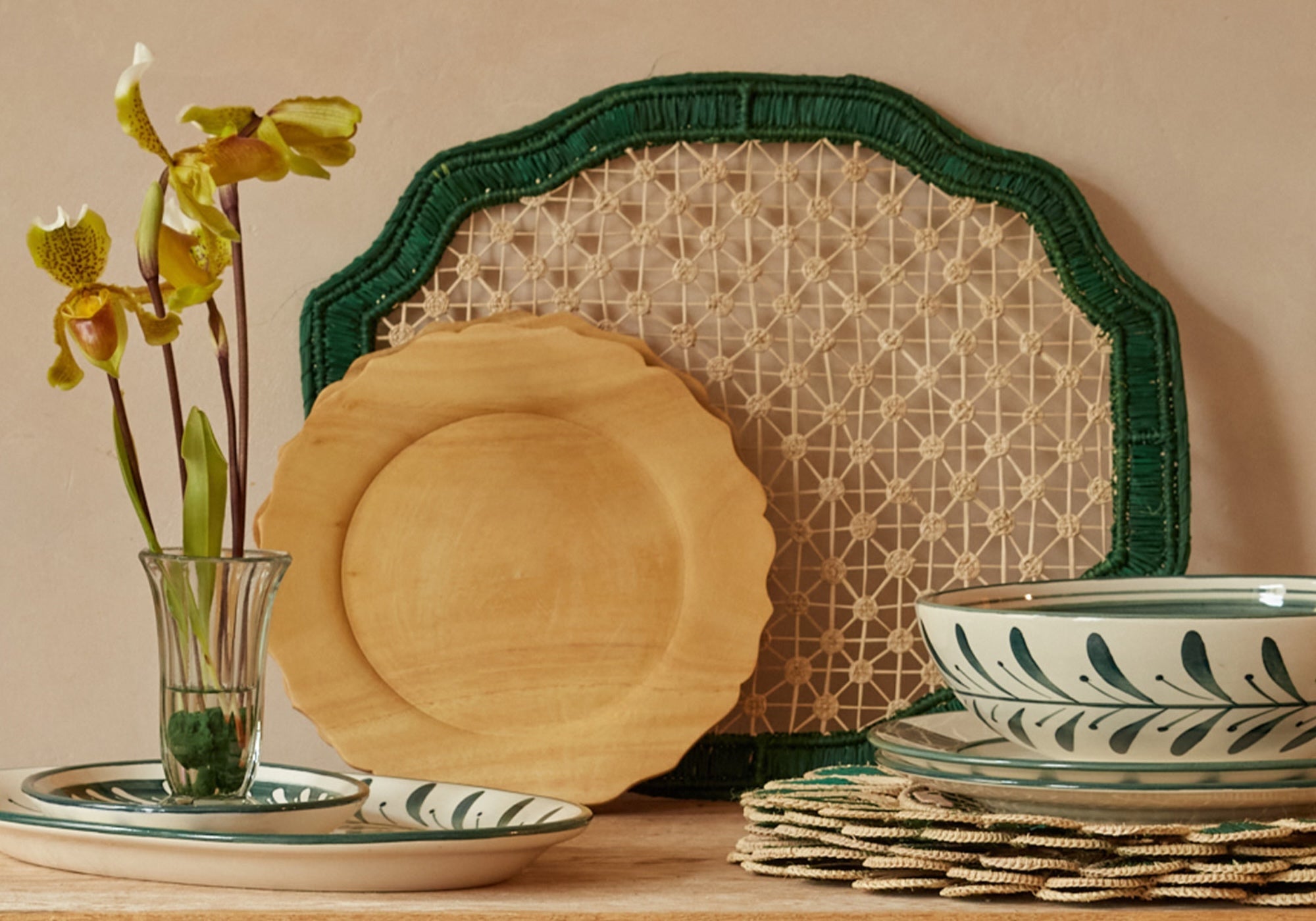
Our Carmen plates are painted freehand by artisans in El Carmen de Viboral, in Antioquia, Colombia, a technique handed down through generations of the town's ceramicists. No transfers, no stencils, which is why no two are identical twins — and, like an ex-voto, the design sits flat on the surface and fills it, with no attempt at depth. We set them against a green floral cloth: pattern layered over pattern, which doesn't fight so much as sing.
Hand-painted in Antioquia


Why did Frida Kahlo wear flowers in her hair?
As a language rather than an ornament — flowers stood for identity, memory and abundance, and she wore them daily, long before a flower crown was a trend.
She carried the landscape with her. In the paintings and in the house, flowers were never arranged to impress; they were there to say something.

The table works the same way. A branch cut from the garden, a handful of tropical stems, a few flowers in a handwoven vase — it isn't elaborate and it isn't meant to be. It just brings the outside in, which turns a meal into an occasion without anybody announcing one.
We let the flowers sit at the edge of the plate instead — not a flower depicted, but a flower built out of the landscape it grew in. And there are two landscapes on this table. The Margarita placemat and the Orquídea ring are woven in Usiacurí from the wild iraca palm, thick and sturdy enough to work around a frame. The Wild Flower ring is the other iraca entirely: the fine, flexible planted variety from Sandoná, the same straw that goes into the hat the world insists on calling Panamanian. One word, two plants, laid side by side.
Handwoven iraca palm


What was Frida Kahlo's relationship with her animals?
She kept spider monkeys, parrots, a Xoloitzcuintli dog and a fawn — and she said more than once that she was more comfortable in their company than in people's.
Much of her life was lived in pain, and much of it feeling misunderstood. The animals asked nothing and judged nothing, and so they moved from the garden into the house, and from the house into the paintings — her two best-loved spider monkeys, Fulang-Chang and Caimito de Guayabal, sit at her shoulder in the self-portraits the way family members sit in anyone else's.
Her kitchen in Coyoacán was famously full: artists, activists, family and animals, with no clear hierarchy between them. Sharing was never an afterthought, and neither was the menagerie.

So we gave our table its own companions. A hand-carved balsa monkey from the Amazon sits among the fruit and the flowers, at eye level with everybody eating — the least sensible object here and by some distance the most fun. A jaguar curls around a napkin, and a toucan and a heron do the serving. Nature in the room, not through the window.
The menagerie, hand-carved


How to set a table inspired by Frida
Start with colour you would actually wear, layer pattern without apology, bring something living in from outside, add one object that has no business being there, and mix what you inherited with what you bought.

Colour you'd wear
If you wouldn't put it on, don't put it on the table. A better test than any palette rule.
Pattern over pattern
A hand-painted plate on a printed cloth. The received wisdom says pick one. The received wisdom is dull.
Something from outside
A branch, a few stems, fruit still on the twig. Height helps — a pedestal lifts everyday fruit into the centre of things and makes it something to pass round.
One object with no business being there
The monkey. A candlestick that's too tall. Something that makes a guest ask.
New beside inherited
Kahlo never curated for symmetry — her grandmother's jewellery went on over folk textiles. Ours went next to a vintage tiled mirror and mismatched glassware. A table that looks collected rather than bought is a table people relax at.
Also on this table


Where can you see Frida Kahlo's work in London?
Frida: The Making of an Icon is at Tate Modern until 3 January 2027, having opened on 25 June 2026 after a first run at the Museum of Fine Arts, Houston.
It traces how she built her own image — the clothing, the house, the table — as deliberately as she built her canvases. Which is a reminder of something we happen to believe: that the way you live and the way you make are the same act.
You don't need a retrospective to set a table with this much feeling. Colour you love, flowers you'd wear, and pieces made to be shared are enough.
Sharon