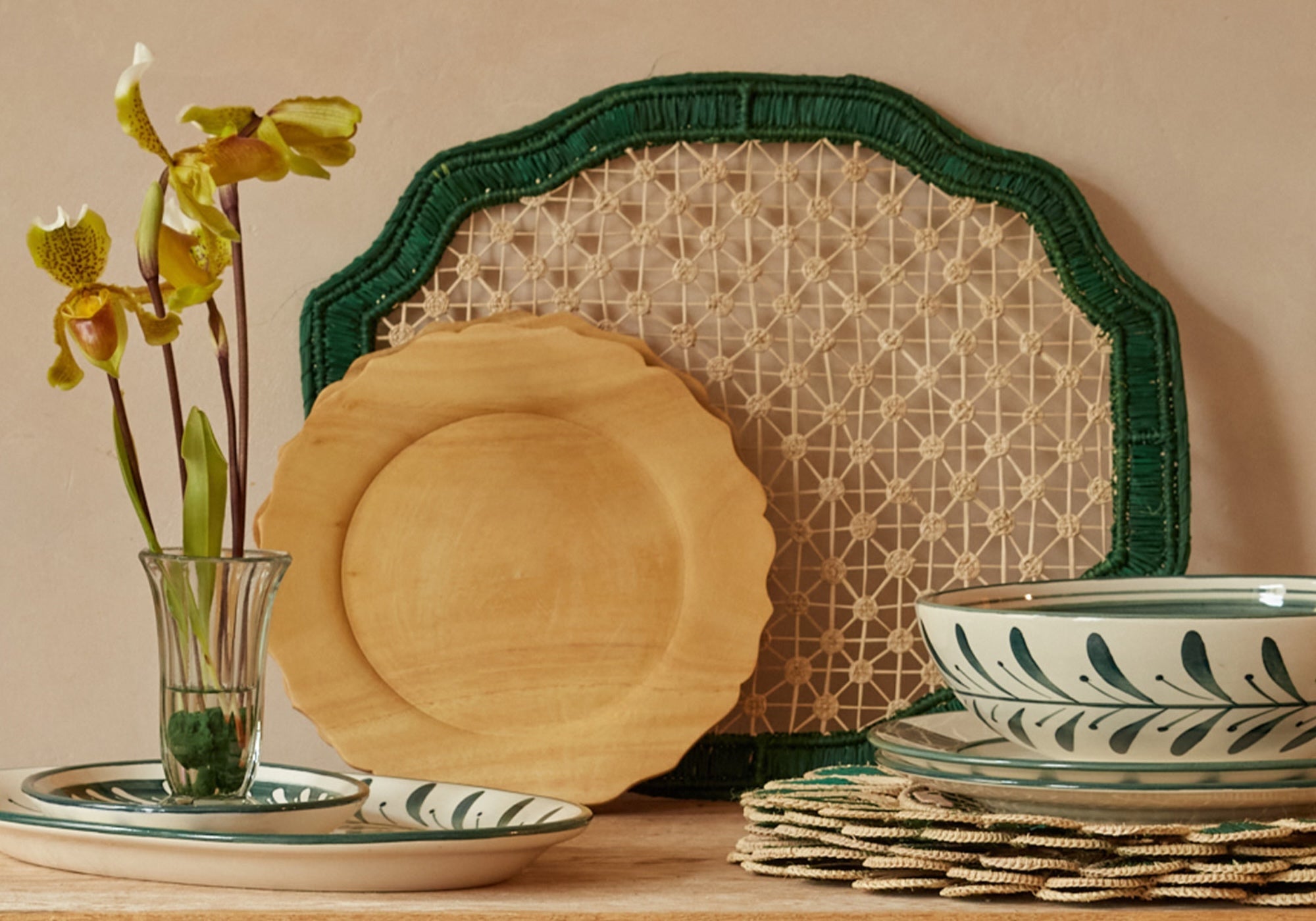
Traditional techniques become the bridge between heritage and contemporary design, allowing everyday objects to evolve while preserving the quiet spirit of their origins. Within the Nostalgia collection, familiar references are reinterpreted through artisan craftsmanship. The Deco Pedestal Fruit Bowl, for example, draws inspiration from a vintage treasure discovered in a Parisian market, reimagined through the warmth and artistry of Colombian weaving. Similarly, the Deco Placemat takes its form from the Art Deco mirrors that once hung in our founder’s childhood home, translating their distinctive silhouette into a woven piece designed for the table today.

Nostalgia in Design: How Memory Shapes Contemporary Homeware


Nostalgia: The Architecture of Memory
There is a particular kind of object that quietly follows us through life.
Not the spectacular pieces, nor the objects chosen to impress. Instead, they are the familiar presences that inhabit the background of everyday life: the hallway mirror that greeted every visitor before they entered the house, a grandmother’s vanity scattered with small treasures slowly becoming family heirlooms, the delicate pattern of old china that appeared at every celebration.
At the time, we rarely pay them much attention. Yet years later, they are often the first things memory returns to.
These objects form the quiet architecture of home — the subtle framework that shapes the spaces where we grow up and the way we come to understand comfort, hospitality, and belonging. Long before we develop a conscious taste for interior design, Nostalgia shaped our visual memory.

We are naturally drawn to spaces that feel layered with time, where newly discovered treasures live comfortably beside objects that carry a sense of history. In such interiors, the small pieces with stories behind them become just as important as the furniture itself. They create a style that feels collected rather than composed, offering a sense of continuity rather than the stiffness of perfection.

It is within this cultural moment that Nostalgia takes shape: a reflection on how the objects that quietly populated our memories can inspire new forms, new materials, and a renewed appreciation for the stories that live inside everyday design.
Observing the Familiar
The collection Nostalgia begins with this observation. Rather than reproducing the past, it asks a different question: how do the objects that shaped our memories translate into contemporary design?
The starting point of the Nostalgia collection was not the desire to reproduce objects from the past, but to observe them more carefully. By studying these familiar silhouettes and proportions, the design process begins with something already understood and lived with.
From there, the objects are reinterpreted rather than replicated. Their essence remains, but the materials, techniques, and details evolve through contemporary craftsmanship.

the Deco Decorative Tray draws its silhouette from the elegant geometry of vintage Art Deco mirrors.
Craft as a Language


https://casalatina.co.uk/products/deco-placemat-deepblue
If observation provides the starting point for the Nostalgia Collection, craftsmanship becomes the language through which these familiar forms are reinterpreted.
Artisan knowledge, passed down through generations, allows traditional techniques to translate everyday objects into something both rooted and renewed. Weaving traditions play a central role in this process. Natural fibres such as iraca palm are shaped patiently by hand, allowing trays, vessels, and table objects to emerge from a technique that carries decades of accumulated skill. The rhythm of weaving gives each piece its subtle variations, reminding us that every object is the result of human hands at work.
Through these tactile materials and traditional techniques, familiar shapes evolve into new objects that feel both contemporary and deeply connected to their origins. Craft allows memory, material, and design to meet — transforming everyday forms into pieces that continue the story of the objects that inspired them.
Reinterpreting Heritage

https://casalatina.co.uk/collections/coffee-break
"Nostalgia is not about looking backwards. It is about bringing memory forward and allowing it to live again in everyday life."