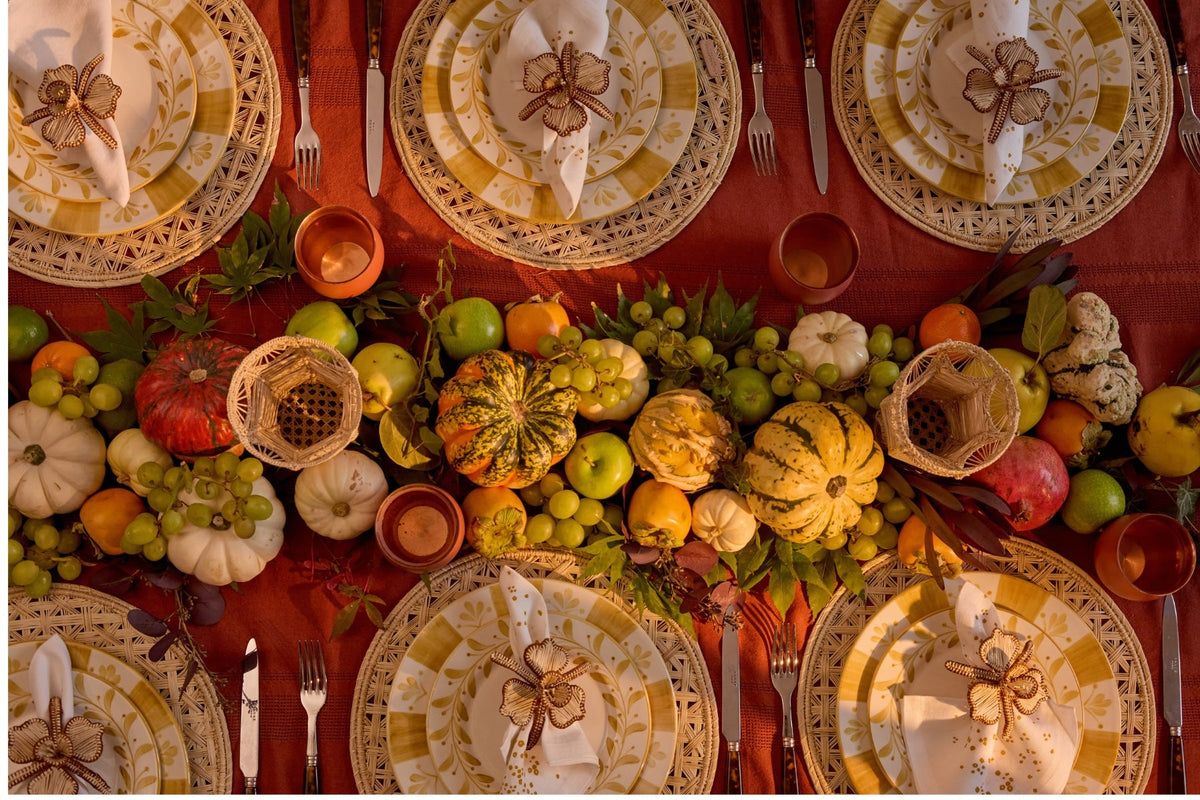
How to let autumn linger, fold it gently into winter, and set a table for the slow months, with this season’s ideas from burrowcore to printmaxxing.
There’s a moment every year when the light changes and I feel the pull to hurry everything along. Put summer away, get the candles out, start planning Christmas. This year I’m resisting.
Some of the best weeks of the year sit between seasons. The last figs are still around when the first clementines arrive. The garden has more seed heads than flowers. The evenings are long enough for a second bottle and no one is in a hurry to leave. Nothing about this time of year asks you to rush, so we’re not going to.
This is our cosy season edit. It’s a table that lets autumn linger, folds gently into winter and borrows the season’s best ideas, without asking you to start again.
In short
The cosy season is the stretch between late autumn and Christmas. It rewards a slower, gradual approach to decorating.
Keep a base you love and change one layer at a time: the centrepiece, the light, the depth of colour.
This season’s trends point the same way: burrowcore (staying in), printmaxxing (layered pattern), deep spiced colours and a renewed love of the handmade.
Handmade pieces, such as black clay, hand-painted ceramics and handwoven palm, carry the table from October to January.
Why let the seasons linger?
Because the in-between weeks are some of the best of the year. Rather than switching your home from autumn to Christmas overnight, keep a steady base and change one layer at a time. It’s slower and costs less, and the table feels lived-in rather than staged.
Interior designers call it a transitional approach. Keep the palette, and change the accents as the weeks go by. It also answers a wider shift in how people want to live at home: less appetite for rooms delivered in a single afternoon, more for spaces that evolve.
A table that has changed little by little over six weeks says something about the people who sit at it. It has been used, enjoyed and added to. That’s the feeling we’re after.
For our table, we set the plates against a rust red cloth, a colour that easily transition from warm to festive
How do you blend autumn into winter at the table?
Start with a base that works in any season, such as natural iraca palm, black clay and a plain linen. Then let three things change week by week: the centrepiece, the light and the depth of colour.
1. The centrepiece. Our Deco Pedestal Fruit Bowl, handwoven from iraca palm in Usiacurí, does the whole season on its own. Fill it with late plums, quince and figs in October, then pomegranates and clementines by late November. By December, add a few sprigs of evergreen. It’s the same bowl in a different mood.
2. The light. Add a candle every week as the nights draw in. By December, the overhead light should hardly be needed.
3. The colour. Move from rust and mustard towards mulberry and deep green. You rarely need new plates for this. Swap the napkin rings, or simply change the tablecloth or the table accessories
The cosy season palette works like a slow fade. Start in October with the colours of the hedgerow: rust, mustard, the brown of a conker. By December they’ve deepened into mulberry and dark green.
What is burrowcore?
Burrowcore is the cosy-at-home trend of autumn 2026: layered textures, low candlelight and earthy colours in rooms made for staying in. At the table, it means slow food served from the pot, warm materials and nowhere else you need to be.
The idea is simple: make home the place you’d rather be. For us that starts in the kitchen, with something slow in black clay.
Our Chamba cookware is made by families in the village of La Chamba, on the banks of the Magdalena River in central Colombia. It’s a tradition that can be traced back at least 700 years. A cocotte goes from the hob straight to the middle of the table, and everyone helps themselves. Mi casa, Tu casa.
Put a bowl of something warm in the centre and a stack of side plates within reach, and let the meal run as long as it wants to.
Shop the look: Chamba Black Clay Cocotte · Chamba Gratin Dish · Chamba Roasting Dish
What is printmaxxing, and how do you use it at the table?
Printmaxxing is layering several patterns in one room, or on one table, so the result feels collected rather than coordinated. The trick is a common thread, usually colour, which lets very different patterns sit happily together.
The table is the easiest place to try it, because everything can be changed by morning. Start with a check or striped cloth. Add a Liliana charger, handwoven from Tetera palm by the MITE cooperative, in Rust. Then add a Flor plate in Rust Red, painted freehand in Carmen de Viboral.
That’s three patterns in one warm family. Finish with a plain linen napkin so the eye has somewhere to rest.
Shop the look: Liliana Charger, Rust · Flor Dinner Plate, Rust Red · Flor Side Plate, Rust Red
Why is handmade the defining trend of the season?
Designers expect a strong turn towards craftsmanship this year. As AI spreads into every corner of design, people are placing more value on the human touch and on pieces that are one of a kind.
Every Flor and Helecho piece is painted freehand in Carmen de Viboral, Antioquia, with no transfers or stencils. No two pieces are identical. Our iraca is woven by hand in Usiacurí, on Colombia’s Caribbean coast, where the craft passes from one generation to the next. Our Werregue baskets are woven by Wounaan communities in Chocó.
These are objects with a maker behind them, and with a story you can tell over dinner. We like to think of them as future heirlooms.
Sharon
How do you set a cosy season table?
Keep a base you love, change one layer each week, layer pattern in a single colour family, cook in what you serve from, light it low and leave something to linger over.
Keep a base you love. Natural iraca and black clay carry you from October to January.
Change one layer each week. Start with the centrepiece, then the candles, then the colour.
Layer pattern in one colour family. Choose a check, a floral and a weave in warm tones.
Cook in what you serve from. A Chamba cocotte goes straight to the table.
Light it low. Add more candles as the nights draw in.
Leave something to linger over. Cheese, a pudding wine or a game of cards keeps everyone at the table.
When should you switch your table to Christmas?
Whenever it feels right, and gradually. Keep your autumn base and add one festive layer at a time from late November: evergreens in the centrepiece, a deeper red, a little more candlelight. The change should feel like the season, not a deadline.
There’s no rule that says Christmas has to arrive all at once. Our table will drift there slowly, one sprig at a time.
Frequently asked questions
What is burrowcore? Burrowcore is an autumn 2026 interiors trend for cocooning at home. It combines layered textures, low candlelight and earthy colours like moss, olive, tobacco, rust and burgundy in rooms made for staying in.
What is printmaxxing? Printmaxxing means layering several patterns, such as stripes, checks and florals, so a room or a table feels collected rather than coordinated. A shared colour keeps it cohesive.
How do I transition my table from autumn to winter? Keep a neutral base of natural materials. Then change the centrepiece, the candlelight and the depth of colour gradually, from rust and mustard in October to mulberry and deep green by December.
How do I care for black clay cookware? Season it before first use and clean it with a soft, non-abrasive cloth. Keep it out of the dishwasher and avoid sudden temperature changes.
Where is CasaLatina tableware made? Our pieces are handmade by artisan communities in Colombia and Venezuela, including Carmen de Viboral, Usiacurí, La Chamba and the Wounaan communities of Chocó. Everything is shipped to the UK by sea.
"There’s no prize for being first to Christmas. Light the candles, leave the washing-up for later and let the season take its time."
With love,
Frida Kahlo is at Tate Modern until January. Her paintings are a lesson in how Latin America uses colour, pattern and nature — a grammar that runs a long way past Mexico. Here is what it teaches, a...